Security, a fundamental human need, has driven relentless innovation throughout history. From the earliest civilizations seeking to safeguard their precious belongings to today’s interconnected world demanding seamless, high-tech protection, the humble lock has undergone an extraordinary transformation. It’s a journey that traces humanity’s ingenuity, adapting to new threats and embracing technological leaps, culminating in the advanced biometric systems securing our lives today. Join us as we unlock the fascinating history of these essential guardians.
The Dawn of Security: Ancient Locks
The concept of securing property dates back millennia, with rudimentary systems involving ropes and knots. However, the first true mechanical locks emerged in ancient civilizations, laying the groundwork for all future security innovations.
Ancient Egypt: The Pin Tumbler Pioneers
|
Our Picks for the Best smart locks in 2026
As an Amazon Associate I earn from qualifying purchases.
|
||
| Num | Product | Action |
|---|---|---|
| 1 | Smart Door Handle Lock with Keypad: Yamiry Fingerprint Smart Knob - Keyless Entry Digital Lock for Front Door - Deadbolt with APP - Generate Passcode Remotely - DIY Installation |

|
| 2 | Smart Door Lock with Camera Fingerprint Keyless Entry Door Lock Electronic Deadbolt with Keypad Code, App Remote Control, Auto Unlock for Front Door |
|
| 3 | Schlage Encode Smart WiFi Deadbolt Lock for Front Door - Keyless Entry with App or Touchscreen - Works with Alexa, Hey Google, & Airbnb - Create Codes for Guests - Matte Black |
|
| 4 | Schlage Encode Smart WiFi Deadbolt Lock for Front Door - Keyless Entry with App or Touchscreen - Works with Alexa, Hey Google, & Airbnb - Create Codes for Guests - Satin Nickel Silver |
|
| 5 | Wyze Palm Lock, Smart Door Lock with Palm Vein Recognition, Keyless Entry Smart Locks for Front Door, Keypad, Auto Lock, Dual Battery, Wi-Fi, Works with Alexa & Google, BHMA, IP53, Mechanical Key |
|
| 6 | Yale Security Assure Lock 2 Deadbolt, Black Suede Keyed Smart Entry Door Lock with Wi-Fi Connected Keypad for Code Entry and Remote Access, YRD410-WF1-BSP |
|
| 7 | TEEHO TE001 Keyless Entry Door Lock with Keypad - Smart Deadbolt Lock for Front Door with 2 Keys - Auto Lock - Easy Installation - Matte Black |
|
| 8 | Wyze Auto-Lock Bolt v2, Fingerprint Keyless Entry Smart Lock, AI Learning Scanner with Wi-Fi Front Door Lock Deadbolt, Auto-Lock, 8 Months Battery, BHMA2, IP53, Anti-Peep Keypad, Backup Keys |
|
| 9 | Tapo Smart Wi-Fi Deadbolt Door Lock – Keyless Tactile Buttons, Customized Access with in-App Monitoring, Auto-Lock, IP54 Weatherproof, BHMA Grade 3, Compatible with Standard Door Sizes, Tapo DL100 |
|
| 10 | ULTRALOQ U-Bolt Pro WiFi Smart Lock with Door Sensor, 8-in-1 Keyless Entry Door Lock with Fingerprint ID, App Remote Control, Built-in WiFi Keypad Deadbolt, Auto Unlock, IP65 Waterproof, Easy Install |
|
Around 4,000 to 6,000 years ago, ancient Egyptians pioneered the pin tumbler lock, a design whose principles remarkably persist in modern mechanisms. These early locks were typically crafted from wood, consisting of a large wooden bolt, a fixed post, and several vertical pins. When the bolt was engaged, these pins would drop into corresponding holes, preventing the bolt from moving. To unlock it, a large, wooden key—often resembling a modern toothbrush with pegs—would be inserted. The key’s pegs lifted the internal pins to specific heights, aligning them perfectly to allow the bolt to slide free. The discovery of such locks, sometimes measuring up to two feet long, in archaeological sites like the Palace of Khorsabad in Iraq, attests to their significance in securing temples, treasuries, and homes.
 Illustration of an ancient Egyptian wooden pin tumbler lock and its large wooden key, showing internal mechanism.
Roman Innovations: Metal and Miniaturization
The Romans, renowned for their engineering prowess, took the Egyptian pin tumbler design and refined it. They introduced metal into lock construction, primarily using iron for the lock bodies and bronze for keys. This shift to metal made locks more durable and robust. Roman keys were also significantly smaller than their Egyptian predecessors, often designed to be worn on rings or pendants, signifying status and personal security. The Romans further enhanced security with “wards”—internal obstructions within the lock that required a key with specific notches or slots to navigate, preventing manipulation by simple tools. While these warded locks offered improved convenience with their smaller keys, they were generally less secure than the pin tumbler mechanisms against skilled manipulation.
Medieval Advancements: Craftsmanship and Complexity
The Middle Ages saw the evolution of locks into more intricate and visually impressive devices, reflecting the heightened need for security in an era of castles, keeps, and valuable goods. Locksmithing emerged as a highly specialized and respected craft in Europe. Artisans meticulously forged elaborate locks and keys, often incorporating decorative motifs and complex mechanisms. These medieval locks typically featured lever tumbler designs or sophisticated warded systems, making them challenging to pick with rudimentary tools. Beyond their practical function, these beautifully crafted locks served as symbols of wealth and authority, with their intricate designs indicating both the value of the protected contents and the status of the owner.
The Industrial Revolution: Precision and Mass Production
The late 18th and 19th centuries marked a pivotal era in lock history, driven by the Industrial Revolution. Advances in metalworking and manufacturing transformed locksmithing from a bespoke craft into a standardized industry, making locks more affordable and accessible to the general populace.
- Robert Barron (1778): Introduced the double-acting lever tumbler lock, a significant leap in security that required levers to be lifted to precise heights both when locking and unlocking.
- Joseph Bramah (1784): Patented his “unpickable” safety lock, a sophisticated cylinder lock based loosely on Egyptian principles but with complex internal layers. Bramah was so confident in his design that he offered a substantial reward to anyone who could pick it—a challenge that remained unmet for 67 years.
- Jeremiah Chubb (1818): Invented the detector lock, which not only resisted picking but also indicated if a tampering attempt had been made by seizing the mechanism. The owner would then need a special key to reset it.
- Linus Yale Sr. (1848): Revitalized the pin tumbler design, creating more reliable and secure versions.
- Linus Yale Jr. (1862): Building on his father’s work and incorporating James Sargent’s combination lock ideas, Linus Yale Jr. developed the modern cylinder pin tumbler lock, the direct ancestor of many locks we use today. This invention laid the foundation for the widespread adoption of high-security mechanical locks.
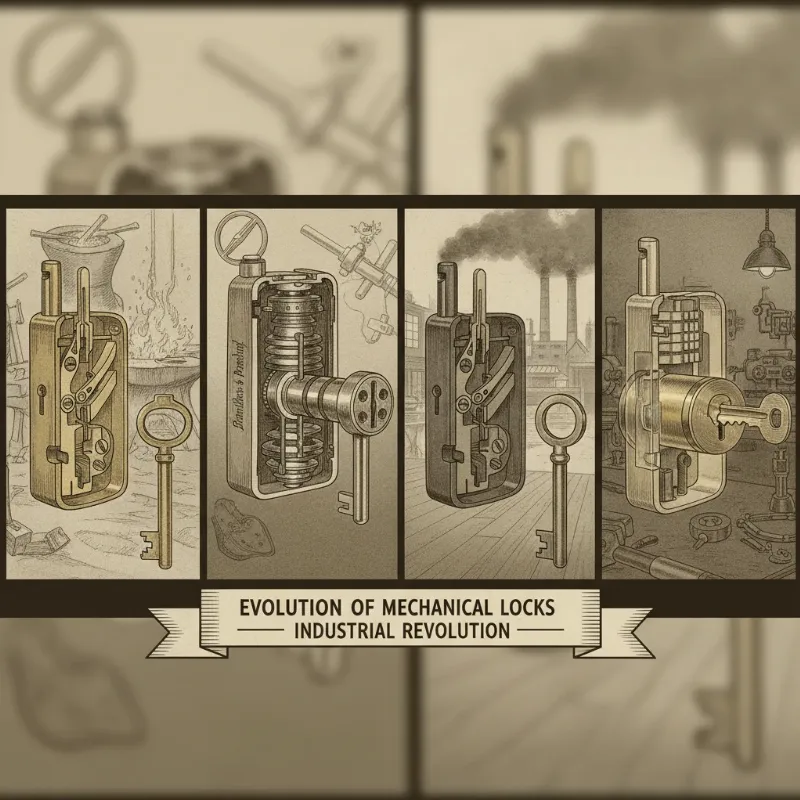 Evolution of locks from simpler medieval designs to more complex industrial-era lever and cylinder locks.
The 20th Century: Electronic Locks Emerge
The 20th century heralded a new era for security with the advent of electronic locks, moving beyond purely mechanical systems. The development of electrical signals to control access marked a significant departure. Electromagnetic locks, or “maglocks,” invented in the 1970s, were a major milestone, using an electric current to create a magnetic bond that secured a door, typically used in commercial and high-security settings. Keycard systems, often employing magnetic stripes or barcodes, followed, offering greater convenience and easier access management in hotels and offices.
The Digital Age: Smart Locks and Advanced Security
The 21st century has been defined by the rise of smart lock technology, integrating traditional locking mechanisms with digital and wireless capabilities. These intelligent devices are revolutionizing how we secure our spaces, offering unprecedented convenience, control, and enhanced security features.
A smart lock is an electromechanical lock designed to perform locking and unlocking operations on a door when it receives authenticated instructions from an authorized device using a wireless protocol and a cryptographic key. They often integrate with broader smart home ecosystems, allowing for centralized control.
Superior Advantages of Smart Locks
Smart locks bring a host of benefits that traditional locks cannot match:
- Convenience and Ease of Use: Say goodbye to fumbling for keys. Smart locks offer keyless entry through fingerprints, PIN codes, key fobs, or even facial recognition. Remote access management allows you to lock or unlock doors from anywhere via a smartphone app, grant temporary access to guests, or receive real-time notifications about who enters and exits your property.
- Enhanced Security: Beyond physical robustness, smart locks incorporate advanced digital security measures. Data encryption protects communication between the lock and your device, while tamper alerts and activity logs provide an audit trail of every entry and attempted entry. Some models integrate alarms that sound during forced entry attempts.
- Intelligent Features: Smart locks are often part of a larger smart home system. They can be programmed to automatically lock when you leave, unlock when you arrive, or integrate with voice assistants for hands-free control. This level of automation streamlines daily routines and enhances overall home security.
- Modern and Diverse Design: Available in a wide array of styles, finishes, and configurations, smart locks blend seamlessly with contemporary architectural aesthetics, offering a sleek and technologically advanced appearance.
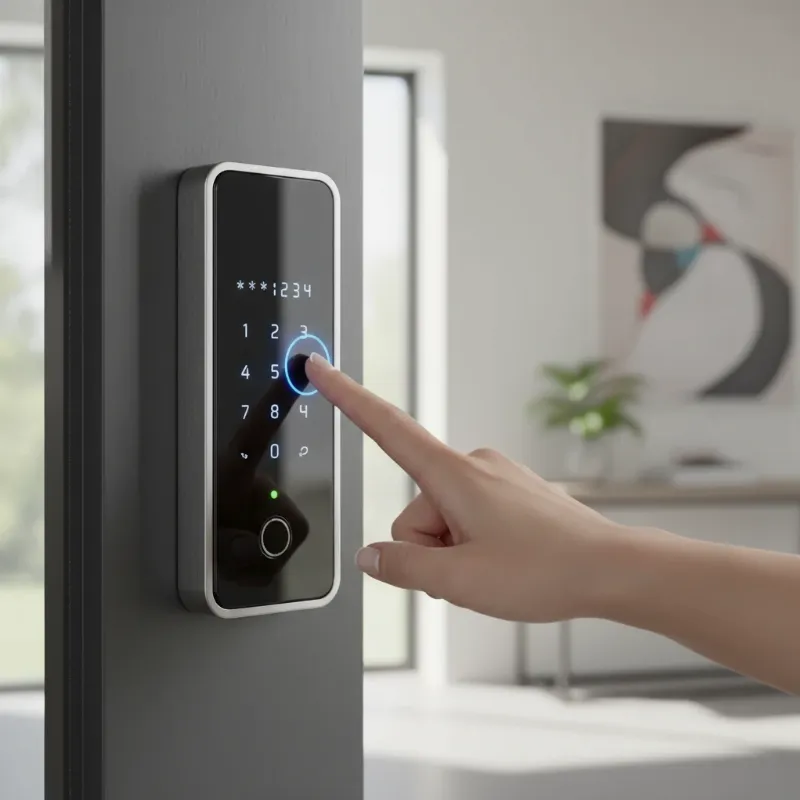 A contemporary smart lock installed on a modern door, showing keyless entry methods like fingerprint or keypad.
Popular Smart Lock Types in the Market
The market offers diverse smart lock technologies, each with unique advantages:
- Fingerprint Locks: Utilizing biometric scanning, these locks offer swift and secure entry with a touch. They are highly convenient for family members and can store multiple user profiles.
- Key Card Locks: Common in offices and hotels, these locks use RFID or NFC technology for access. They are easy to manage, allowing for quick revocation of access if a card is lost or stolen.
- Keypad Locks (Code Locks): Entry is gained by entering a numerical code. These are popular for rentals or service access, as codes can be easily changed or issued temporarily. Advanced models feature “scrambling” functions to prevent code detection by smudges.
- Facial Recognition Locks: Representing cutting-edge technology, these locks use advanced cameras and algorithms to verify identity. They offer hands-free, high-security access, though they typically come at a higher cost.
- Remote-Controlled Locks (Bluetooth, Wi-Fi): These locks can be controlled via a smartphone app. Bluetooth models are ideal for close-range control, while Wi-Fi locks offer global remote access and integration with smart home hubs.
Comparison Table of Smart Lock Types
| Feature | Fingerprint Lock | Key Card Lock | Keypad Lock | Facial Recognition Lock | Remote Control Lock |
|---|---|---|---|---|---|
| Security Level | High | Medium | Medium | Very High | High |
| Convenience | High | Medium | High | High | High |
| Cost | Medium | Low | Low | High | Medium |
| Suitable For | Homes, Offices | Offices, Hotels | Homes, Rentals | Luxury Homes, High-Sec | Homes, Rental Units |
How to Choose the Right Smart Lock
Selecting the ideal smart lock requires careful consideration to ensure it meets your specific security and lifestyle needs.
- Determine Your Needs:
- Door Type: What kind of door will it be installed on (wood, metal, sliding)?
- Security Level: How much security do you need? Basic convenience for a back door or robust protection for your main entrance?
- Budget: Smart locks range widely in price, so set a realistic budget.
- Key Features: Do you prioritize remote access, biometric entry, or integration with a specific smart home system?
- Research Reputable Brands: Look into leading manufacturers known for quality and reliability. Popular brands often offer a range of products with good customer support.
- Compare Features and Specifications: Look at battery life, connectivity options (Bluetooth, Wi-Fi, Zigbee, Z-Wave), compatibility with other smart home devices, and advanced security features like tamper alarms and auto-locking.
- Read User and Expert Reviews: Real-world feedback can highlight practical aspects, ease of installation, and long-term performance.
- Check Warranty and Support: A good warranty and responsive technical support are crucial for any electronic device.
Tips for Using and Maintaining Smart Locks Properly
To ensure your smart lock operates reliably and securely for years, follow these best practices:
- Regular Battery Replacement: Smart locks rely on power. Replace batteries proactively, typically every 6-12 months, or as indicated by low battery alerts.
- Routine Cleaning: Keep the lock mechanism and any biometric sensors free from dust, grime, and fingerprints to ensure optimal performance. Use a soft, dry cloth.
- Frequent Software Updates: Manufacturers regularly release firmware updates to fix bugs, improve performance, and patch security vulnerabilities. Enable automatic updates or check for them regularly.
- Safeguard Your Access Credentials: Never share your PIN codes, key cards, or biometric data with unauthorized individuals. Use strong, unique PINs and enable two-factor authentication if available.
- Contact Support for Issues: If you encounter persistent problems or malfunctions, contact the manufacturer’s customer support rather than attempting complex repairs yourself.
Common Smart Lock Issues and Troubleshooting
While smart locks offer immense convenience, users might occasionally encounter issues. Here are some common problems and their solutions:
- Fingerprint Not Recognized: Ensure your finger is clean and dry, and the sensor is free of smudges. Re-enroll your fingerprint if the issue persists, and try enrolling multiple angles of the same finger.
- Dead Battery: The most common issue. Replace batteries immediately. Many locks have a fail-safe (like a physical key override or emergency power terminals) for this scenario.
- Lock Jamming: Check for any physical obstructions in the door frame or bolt. Sometimes, misaligned door frames can cause the bolt to stick.
- Connectivity Problems: If your Wi-Fi or Bluetooth connection drops, try restarting your home router or the lock itself. Ensure the lock is within range of your Wi-Fi extender or smart home hub.
- Hacking Concerns: While rare, robust encryption and multi-factor authentication mitigate risks. Keep firmware updated and use strong, unique passwords for associated apps. Consider a smart lock with a physical key override as a backup.
The Future Trends of Smart Locks
The trajectory of lock technology continues upwards, with future innovations promising even more sophisticated and integrated security solutions.
- Artificial Intelligence (AI) Integration: AI will enable locks to learn user patterns, detect unusual activity with greater accuracy, and even anticipate potential security threats, providing predictive maintenance alerts and smarter access control.
- Enhanced Connectivity with IoT: Smart locks will become seamlessly integrated into comprehensive Internet of Things (IoT) ecosystems, communicating effortlessly with other smart home devices like cameras, lighting, and thermostats to create holistic security and automation routines.
- Blockchain Technology for Security: Blockchain could revolutionize lock security by providing decentralized, immutable records of access events. This technology can enhance data integrity, prevent tampering with access logs, and even facilitate secure, trustless access granting via smart contracts.
- Advanced Biometrics: Beyond current fingerprint and basic facial recognition, future locks will incorporate 3D facial mapping, vein recognition, and even iris or gait analysis for ultra-secure and spoof-resistant authentication. Multi-modal biometric systems, combining several biometric methods, will become standard for critical access points.
- Voice and Gesture Control: More intuitive interfaces will allow for hands-free control, integrating advanced voice recognition and even gesture-based commands for unlocking and managing access.
Expert Insight
“The evolution of locks demonstrates humanity’s persistent drive for security. From ancient wooden mechanisms to cutting-edge biometrics, each innovation reflects a new understanding of protection, convenience, and the sophisticated integration of technology into our daily lives.” – Sarah Chen, Cybersecurity Futurist
Conclusion
From rudimentary wooden contraptions in Ancient Egypt to the intelligent, connected devices of today, the history of locks is a testament to human ingenuity in safeguarding what matters most. We’ve journeyed through millennia of innovation, witnessing the transformation from simple mechanical barriers to sophisticated smart locks that offer unparalleled convenience and security. These modern marvels, embracing biometrics, AI, and IoT, are not just about keeping intruders out; they are about integrating seamlessly into our lives, providing peace of mind, and offering a glimpse into a future where security is both intelligent and invisible.
Embrace the next chapter in home security. Discover how the latest smart lock technologies can protect your home, streamline your life, and provide the ultimate peace of mind.
Frequently Asked Questions
Are smart locks more secure than traditional locks?
Yes, generally, smart locks offer enhanced security compared to traditional mechanical locks. While a traditional lock relies solely on physical integrity, smart locks combine robust physical construction with layers of digital security, including encryption, multi-factor authentication, tamper alerts, and activity logs. This digital layer makes them more resistant to conventional lock-picking methods and provides real-time monitoring and control that traditional locks lack. However, like any connected device, their security also depends on strong passwords and regular software updates.
How long do smart lock batteries typically last?
The battery life of a smart lock varies depending on usage, battery type, and features, but typically ranges from 6 to 12 months. Factors like frequent locking/unlocking, Wi-Fi connectivity, and motor usage for automatic locking can affect battery longevity. Most smart locks provide low-battery warnings well in advance, and many offer emergency power options or traditional key overrides for continued access.
Can smart locks be hacked?
While no system is entirely impervious, modern smart locks are designed with robust encryption and security protocols to resist hacking attempts. Potential vulnerabilities usually stem from weak user passwords, unpatched firmware, or unsecured home networks rather than inherent flaws in the lock’s core technology. Keeping firmware updated, using strong, unique passwords, and enabling multi-factor authentication significantly reduces the risk.
What happens if my Wi-Fi goes down or I lose power?
Most smart locks are designed to function even during power outages or Wi-Fi disruptions. They typically store access codes and biometric data locally, allowing manual entry via keypad, fingerprint, or a traditional physical key override. Wi-Fi dependent features like remote control and notifications will be temporarily unavailable, but the core locking function remains operational.